viernes, 14 de noviembre de 2014

"A walking hard-drive": a tale from "Amarás en Guerra" (in English)

WARNING
The following text is a fictional story concerning Id, one of the gods that appear  in the Novel "Amarás en Guerra", but is not part of the Novel.  The text contains crude language and images. Discretion is adviced.

A walking hard-drive.

By: Arturo B. Loranca


It was one of those things that survived an era by diversifying, which basically meant that:

A. Although it was still an efficient commodity, its real purpose had changed, so, in principle, its identity was conflicted. In fact, it was so conflicted about what it was, that at times it thought itself a man, but how could it not? Part of its new usefulness brought him in contact with perks and pleasures that most men could only envy;

B. It couldn’t help to have an utter disregard for its own endeavors and the consequences thereof. It just did not care what they did with it/him (as delusion would have it) and;

C. It/he felt old, way too old: An old man that was not old and not a man.

The product of cyberpunk-aficionado engineers working with defense contractors, it was the ultimate way to transport secure information in the nineties.  A volunteer-  say college dropout or army-recruit-seeking-citizenship-  was outfitted with a terabyte hard-drive in his/her abdominal cavity allowing an i/o cable and port to emerge strategically trough the volunteer’s umbilical cavity. The drive was somehow connected to the volunteer’s heart and programmed to delete itself should the poor shmuck’s heart-rate exceeded 180 or came to 0.  The idea was to create a way to move information without the risk of signal jamming, intercepting or hacking by using couriers that could not reveal the information they were carrying when intercepted, tortured and/or killed on route.  Should the courier face any mortal danger, his/her heartbeat would rise and the drive would erase (which would left torture and threats out of the picture if you wanted to get the information), should the courier be killed or separated from the drive, the drive would erase (which would left killing and mutilation out of the picture if you wanted to get the information).  You could bribe or sleep the carriers to get access to their ports, but later models had another built-in safety feature: the i/o port of the drive would only activate if an 8 digit code was punched-in through a special dial that could be outfitted in the I/O port itself.

Normally, the courier would not know the code for the I/O port, so bribing or putting them to sleep was also useless… If your intention was to retrieve the information.

Turned out that most intelligence agencies didn’t care as much for the retrieval of the information sent by their counterparts as they cared for preventing its delivery, so the idea, which was very successful in the early years of the 21st century, was abandoned because it was just not cost effective.

Outfitting the drive in the couriers was not that expensive, but it was more expensive than a bullet or a good scare to crash the delivery.

Only certain individuals with the ability to keep their wits about them when facing danger were selected for upgrades and to remain"in service", the rest were either killed in the line of duty or allowed a fairly peaceful existence as a way of thanking them for making their part in the development of new technologies (besides, it was more expensive to remove the drive than to just let them live with it).

The “old man that was not old and not a man”, was one of those that were left behind in the evolutionary race; an aberration by Darwinian standards. It/he was not as fit as its peers but still survived, lingered in obsolescence in a world that was not supposed to be its own. A cassette that only a few had a player for (do you even know what a cassette is?).

It was mostly used by seedy companies that did not want to send information of their money laundering operations through un-secure channels or child pornographers that needed to deliver their digital products.

If it was caught –which happened a lot more than it/he’d liked to admit- the information he/it carried was forever lost and that meant living free to operate another day both for “the tool” itself and its employers, who, by the way, would have to handle “the tool” with the outmost care and provide it with all manner of “stress relievers” such as comfort suites, first class tickets and rides, good food, good wine…  “High maintenance” if you will, but maintenance just the same. Maintenance for a walking, almost sentient, information storing unit; requirements for a new breed of homing pigeon to operate.

Authorities couldn’t pin it/him for shit, as its/his business was completely legitimate.  As per contract, people using it (retaining its services) was required not to disclose the nature of the information they downloaded on it and the tool itself never had the 8 digit code to activate its i/o port. 

Even if there was a suspicion of unlawful materials being carried, there was no way for prosecutors to go beyond the reasonable doubt and indict “the tool”, after all, transport of undisclosed confidential information was not a crime in any of the countries it was commissioned to go.

If things got too hot and/or the owners of the information couldn’t or wouldn’t retrieve it, “the tool” would delete the information by racing his pulse, which meant dropping a nitro pill or getting and adrenaline shot (god forbade it just jumped into a treadmill).

The “old man that was not old and not a man” seemed fat, not only because the drive in his belly protruded its guts out, but because the “maintenance” didn’t help a slender figure.  Not that it cared of course. His/ts appearance helped it/him disappear amongst the passengers at first class (seldom young, seldom fit) to the point that you could only spot him trough a careful analysis of the eyes in the crowd.  Even the most vile and jaded of men have some spark in their casual glance; a bright of malice, a sign of erosion, a light that begs for the recognition of a blurred humanity to manifest, but its/his eyes, as the eyes of a tool, were just two pools of polished nothing; mechanical indicators that it was operating, nothing more.

It was bound to Narita Airport to deliver the information that a weird new client paid tons of money to send.  As usual, it did not care who the client was, what the information was, or who was to receive it.  The contract was signed, the advance was paid and the upload was made. Upon confirmation of payment completion (at Narita) he would take a taxi to the designated address and procure his belly for download… Another day... Maintenance gained.

It had a couple of drinks before takeoff. It was night. Schedule subject to the requirements of service.

No big deal.

As the plane reached the altitude for those of the lower classes to lean back their seats, “the tool” started to feel the real weight of three ounces of whisky on its eyelids, so he left his consciousness drift with the plane into the blackness of the night sky.

01….110001…. 000000….. 1111….
1: TO BE
0: NOT TO BE

Flashing in and out of being, she became aware.

Confined in a solid unit of preservation linked to somebody else’s body… Was it her mother? Was this some kind of new uterus she did not knew?

She tried to move but she couldn’t, she was fixed in a sort of magnetic support, her being in uncomfortable magnetic pulses which could translate as a story in the eyes of a reader or as a spirit hidden in the dark corners of everyone’s mind.

Her name was Id. Once male, now female, a dream that someone once had, lost to the waking hours.  

Could it be? Somebody else was dreaming her again?
 Not exactly. Sombody had managed to encased her in a terabyte hard-drive and she was being transported over the Pacific on a plane (but she did not know that, she just wanted "out").

As the whisky shut its/his eyelids, the tool’s  terabyte-drive had activated. It was not supposed to be possible but, it happened. The information in the hardware started to came into being. It was not a snuff film or the ledger of some South American mobster or the photo of an unfortunate child in the hands of an evil priest, it was one of the forgotten lords of shaping, a creature of pure information, a self aware virus that we, lesser creatures can only phantom as a god…. And gods work in mysterious ways.

A terrible flash-like pain in the stomach woke him/it, a sting from the inside.

Back when it/he was a man, the technicians had told him that the equipment could get magnetized somehow and could produce little discharges from time to time.  Never had happened, but at the moment It/he thought "that was it", the tool tried to convince himself/itself that “that was it”. After all, all other alternatives would probably require urgent surgery that most planes don’t have when crossing the Pacific… Then it noticed that its drive was on and something was happening in the place where its intestines should be.

At first it did not hurt, it just felt like uncountable fingers touching its guts as infants playing with something they don’t fully understand but can squish between their fingers. The touching it/he could take, the squishing… Not so much.

The tool started yelling as its/his gut claimed the right to be on the other side of the seatbelt or maybe in the ceiling of the cabin. At that point, certainties were pushed against pressured windows, all passengers in the vicinity started thinking about 9-11 and blood started to sprout from the tools i/o port as the screaming seemed to made it, whatever it was, gained mass against the tool’s hundred dollar shirt.

It/he tried to get the “chill out” pills from its pocket as chaos ensued from her attepts (Id’s) to break into existence in the otherwise aseptic ambient of white indifferent lights that are supposed to push calm onto the defenseless people that ride a plane at 30,000 feet, but the pain… The pain!

Stewardesses came running as the sick fantasies of engineers addicted to sci-fi and cyberpunk crowned on the tool’s stomach with the head of a woman ripping its way to existence in a mixture of guts, circuits and beautiful features while the tool’s pulse… Its/his pulse… The pulse of the walking hard -drive exceeded 180 by a landslide, but its contents apparently refused to be deleted. On the contrary, they grew out of him and continue to take shape (Id's shape), the shape of a godess bursting trough its/his stomach.

Id’s head finished its way trough the human hard-drive  and started to emerge into the seats of first class' screaming chorus... It is a hell of a thing to see a woman's head emerging from a fat-mans belly, that I can say... A vision, or rather a post-card from hell...

Everyone in the cabin was engulfed in a terror wave that many translated to sickness and others, tears of anguish. A shoulder was already showing, and it seemed like the birth was going to came to furtuition as grotesque and impossible as it would seem to everyone, however, as her features started to roll out from the gore that once was the human hard-drive, the godess stopped it's way into our world. The drive had a terabyte capacity after all and it was designed more than 20 years ago... It took about 5 minutes to purge after Jonathan Queen (nee Juan Reina), the human hard-drive, died and the thing growing out of his/its stomach (Id) found herself aborted in the first class section of a comercial flight.

Obsolesence is a bitch, whether you are a human, a tool, or a god.


sábado, 13 de septiembre de 2014

¡Los 75 de Bats!

Quizá no lo sabían - por lo regular ninguna persona normal lo sabría - pero en 1939, una revista de historietas llamada "Detective Comics" dio a conocer a un personaje que en su época simplemente fue un justiciero más, pero que millones de historias y cientos (si no es que miles) de escritores después, se convertiría en el único personaje humano capaz de vencer a un panteón de dioses que en la página pueden  partir el planeta en dos con un solo golpe: el caballero de la noche, un símbolo de lo que se supone que la obsesión y la voluntad humana pueden lograr, nuestro señor, Batman ("Bats" para los cuates).

Ok, si, soy un fan del personaje.  Creo que me ha fascinado en todas sus encarnaciones y personificaciones y es que hay algo maravilloso en pensar que cualquiera de nosotros sería capaz de controlarse al grado de lograr condiciones físicas superiores a un atleta olímpico y procesos mentales más allá de IQs de premios Nobel.  Aunque parezca de plano cosa de deficiencia mental, Batman de alguna forma me parece una figura inspiradora (si él es capaz de pelear toda la noche y al día siguiente irse a la oficina, ¿acaso no voy a poder correr míseros 42 kilómetros o arriesgarme para lanzar mi proyecto soñado?).

Dicho lo anterior, realmente me emocioné al saber que México se uniría a las celebraciones del 75 aniversario del personaje y haría la exposición que se ha hecho con la fundación "Make a Wish" en otros países del mundo, dando a artistas locales la oportunidad de dar su versión de la máscara más fantástica en el mundo de los comics (repito, soy fan y para mí la máscara de Batman es la más fantástica).

Aprovechando la ocasión, llené una bolsa de ejemplares de nuestra novela y me lancé a la exposición para ver qué tan bien nos recibían en una fila de más de 2 horas y media.  Afortunadamente en ese tiempo pude repartir algo así como 40 ejemplares de nuestra novela y bueno, no sé si sería porque cualquier cosa es buena para distraer la mente cuando se esta en una fila de apariencia interminable, pero los que recibieron nuestra novela perecieron apreciar algo que leer.


A continuación una pequeña semblanza de las maravillosas creaciones que vimos y que serán subastadas, así que mejor verlas aquí porque quién sabe dónde queden después de que las vendan.


Esta es por Bernardo Fernández (Bef) famoso escritor e historietista, ganador de muchísimos premios, colaborador de Editorial Resistencia y para acabarla, compañero de la preparatoria.  La verdad no fue de mis favoritas, pero bueno, se es solidario.


Esta por Rafael Gómez y Belén Moy me pareció muy linda.  No la más imponente, pero la Poison Ivy al flanco me mató (lo siento, de ellos tampoco pude encontrar mucho en línea).


Esta es por Mr. Mitote (Heriberto Rodela) un genio de las figuras de vinyl. Me gusto sobre todo por el baty-gato que tiene arriba.  Si pudiera yo creo que esta sería la que compraría (claro que si tuviera dinero para tales menesteres ya me habría comprado de menos uno de sus muñecos más sencillos. Vean su página, tiene hasta chanclas que están muy, muy adecuadas).


Esta de Estudio Zoveck me pareció especial porque captura, según yo, la esencia de la calavera de día de muertos, una de nuestras fiestas más entrañables en México.


Esta es de Ulises Daniel Hernández Bocanegra, quién como pueden ver, se fue por el motivo prehispánico de la variedad que parece recién sacado de la excavación.  El detalle de las lágrimas rojas me pareció que remite a una nostalgia por un pasado ya extinto (lo lamento, tampoco  pude encontrar mucho de Ulises en la red).


Esta, es por David Kimura,  genial artista de grupo Horma. Si se fijan el patrón de la capa está constituído por figuras de los enemigos del encapotado.  Un detalle sutil que sin embargo se me hizo perfecto.


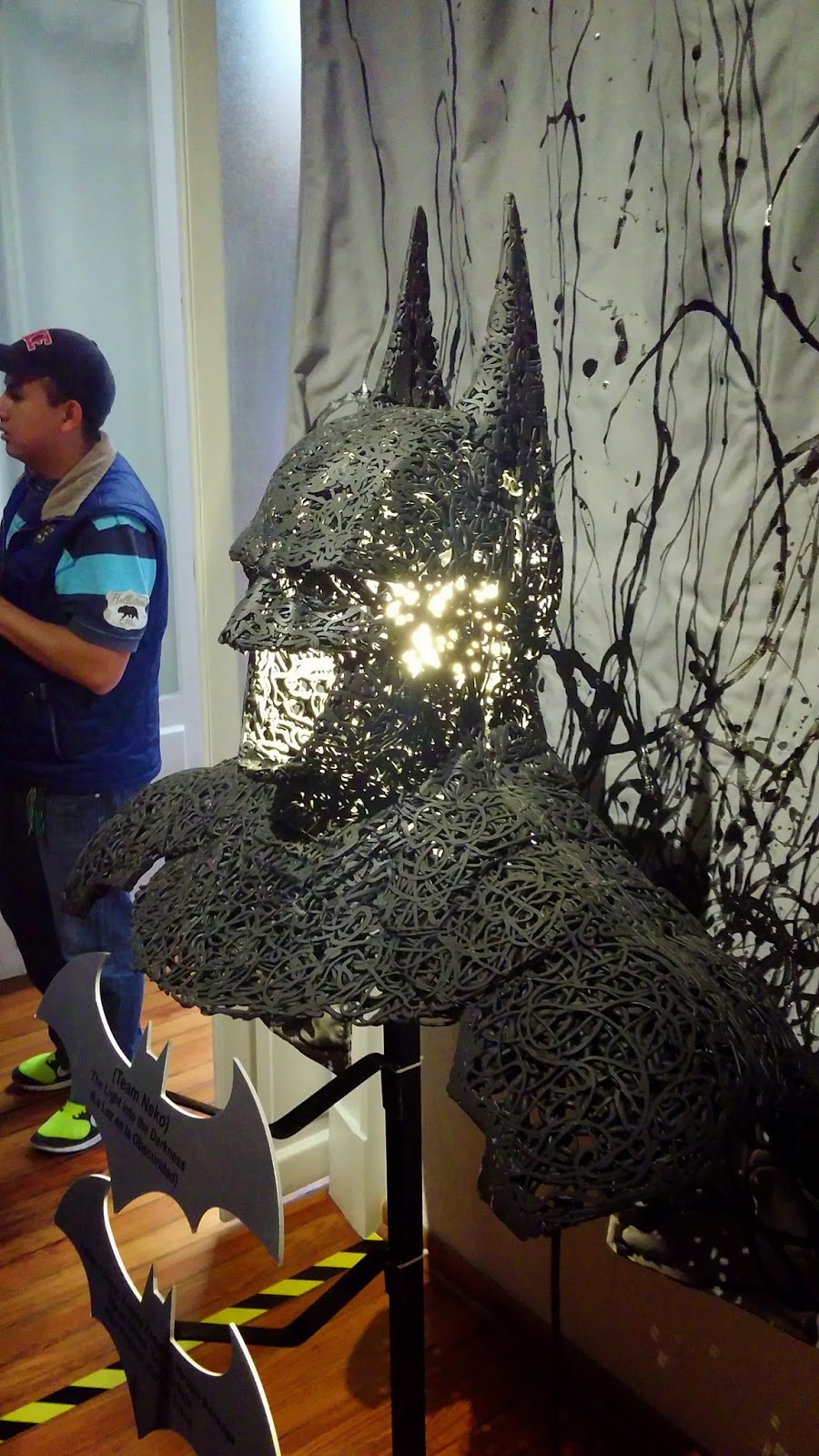
Esta maravilla es por Estudio Neko, una firma de diseñadores industriales involucrados más bien en la creación de obras que inter-actuen de alguna forma con el entorno.  En este caso, la obra se asume elaborada en función del filtrado de luz sobre el negro (oscuridad).  Uno de los diseños más sorprendentes.


Otra obra con motivos prehispánicos, en este caso, Camaztoz, un demonio "vampírico" de la mitología mesoamericana.  El autor, Christian Pacheco Kimbal es un artista multidiciplinario que pisa por el grafiti, la escultura y... Bueno, también los cascos del caballero de la noche.


Como soy fanático del arte en blanco y negro, esta, de Cecilia Beaven, me fascinó.  El motivo es el murciélago como tal y así nos lo indica la capa con nombres de quirópteros como si fueran consignas de protesta.  Viendo quién era Cecilia, me topé con su página y me fascinó su trabajo de animación, les recomiendo le echen un ojo. 


Esta es definitivamente la más elegante. El Batman Oaxaqueño en aparente barro negro y con una capa tejida como tapiz de noche, una maravilla artesanal que también me fascinaría tener en casa.  Los artistas son del equipo del Despacho creativo llamado Bamf con Antonio Serrano. 

Por último, les persento la obra de Bern Baños, de Toloache Toys (con diseños muy buenos, también los recomiendo), también basado en las deidades vampíricas de mesoamérica con una capa verdaderamente impresionante.


Y bueno, no lo pude resistir


Espero que les haya gustado este viaje por las maravillosas obras de los artistas mexicanos que participaron en la exposición.  Recuerden que seguiremos repartiendo gratuitamente nuestra novela en diferentes eventos durante el resto del año y si, no podría despedirme de ustedes sin decir "¡Felicidades Bats!"


Arturo B. Loranca


viernes, 5 de septiembre de 2014

An English Summary of the Novel (DO NOT READ IF YOU SPEAK SPANISH)


BEWARE!


In this section you will find a summary of the novel "Amaras en Guerra" as understood by one of our friends. It does not address all the situations and characters in the novel but does provide a general depiction of the whole.
This summary is the ultimate spoiler so if you do speak spanish WE STRONGLY encourage you to read the novel instead of the summary as the novel is designed for multiple interpretations and this is just one of them.

We are publishing this summary because at the moment we do not have an English version of the novel but we want our English speaking followers to know its contents.  We are doing a crowd funding campaign to edit a definitive version of the Novel which will contain 11 new chapters. If there is enough interest we will make an english translation so please, if you want to support our project, contact us at amarasenguerra@gmail.com

"Complex interplay of politics and characters. Sounds great!"

Jake Kerr, author of "The apocalypse triptych" (About the summary) 

Ok, here we go....

First off, a little explanation is in order.

The title of the novel is "Amarás en Guerra" which has two translations as "Amarás" is both the name of a place and the future tense of the verb "to love".

"Amarás en Guerra" then means "You shall love at war" and "Amarás at war".  Ok, now here we go...


DO NOT READ ANY FURTHER IF YOU INTEND TO READ THE  NOVEL!
YOU HAVE BEEN WARNED!


Once upon a time…

There was an Empire called “Europa”.  Europa is a feudal society ruled by a single Emperor with the aid of the Holly Church, which controls magic/technology/knowledge, which in turn, is allegedly a gift from the gods to their flock, the people of Europe (according to the Gospel,  foreigners can't use magic).

On the other side of the planet, there is a cluster of huge Islands called “The Confederation”. The Confederation is ruled by a council of guilds and two orders: the order of beggars, which were judges and lawmakers, and the order of the blade (or Han), which were warriors in the service of the beggars.

Europa and The Confederation were at war over an Island that served as the only outpost for European ships to make port before reaching the cities of the Guilds at the other side of the world.  That Island was Amarás.

At the end of the war, which caused European Emperor Siegfried the 2nd to abdicate in favor of Edmundo Barieri the 1st, Amarás was won by the Empire.

To support the armistice, Edmundo the 1st and the leader of the most influential guild in the Confederation agreed to marry their respective heirs, so princess Zafiro of Europa and Daimo Yu Xiao of the ship building guild were promised to be married during Amarás’ passover, however, a forgotten European god called Tul, appears.

Tul, also called the “sorrowful”, was supposed to be asleep, but suddenly he attacks the Conclave of the Holly Church and starts pouring a deadly red mist over Amarás. 

Plans for the wedding continue as planned because no one wants to acknowledge the existence of Tul and during the first official ball in Amarás, where Zafiro and You Xiao are to meet, Tul attacks. 

Werther Walner the 3rd, known as "Die Drei", son of the nephew of the former Emperor (who abdicated during the war), and Zafiro’s last lover, appears at the ball and tries to “save” the princess, but as a good agent of the Empire, she is not going anywhere.

Die Drei tries to force her to leave so the princess shots him, however, Yu Xiao, a selfless pacifist (with issues against guns) takes the bullet for Die Drei, who, in turn takes the opportunity to subdue Zafiro.  Not having the heart to leave his savior, Die Drei escapes with both Zafiro and Yu Xiao to a neighboring Island called “Uthul”.

The Emperor is then contacted by Werther Walner the 2nd, father of Die Drei, who claims that the princess has been “arrested” and that she will be released only if the Emperor agrees to marry her with his son.  Former Emperor, Siegfried Walner the 1st appears and makes it very clear that he resents Emperor Edmundo and wants the Walners to re-take the imperial throne. Apparently Tul has been working for the Walner family from the start.

While all this happens, we learn that Tul has never been asleep and lives inside two individuals very close to the main protagonists of the story:  Jenamar,  Zafiro’s ferocious escort (who is also the only female Archmage from the Holly Church and Zafiro’s oldest and dearest friend) and Kai Xiao, Yu Xiao’s youngest  brother who went missing for many years and returned home apparently crazy.

Tul takes over Jennamar’s body and helps the Walner’s to secure the aid of the Dirustanti’s, Jennamar’s family and rulers of the south east part of Europe.

At Uthul, Die Drei realizes that Zafiro really doesn’t love him and decides to leave her locked away to die in the underground mine they are hiding in.  Yu Xiao frees her and they begin to roam the tunnels trying to find a way to get out since Die Drei apparently destroyed the only elevator after leaving.

The Empress, Johana Bach, a famous musician considered to be a child prodigy since the last days of Emperor Sigfried the 1st, goes to pray to Ars (the god of forms) for the safe return of her daughter and is met by Tul.  Tul confronts her and makes her see that Ars, the god she prayed to, actually raped her when she was younger and lives as a human in the imperial Court.  Tul also makes Johana see that everything that has happened (the war, the church’s dominance and the Empire’s hegemony) was caused by Ars, because he is a self-absorbed god that revels on adulation and wants a world of his own design where he can live happy.  Johana then discovers who is the incarnated Ars and kills him (along with the Magus, the highest authority of the Holly Church).

Zafiro and a very badly injured Yu Xiao, keep roaming the underground tunnels and they realize that they are being led to somewhere by someone that has been watching them.  They arrive at a huge cavern where they meet cave dwellers (horribly mutated natives of Uthul) that kneel to Tul/Jenamar.  Tul/Jenamar tells his/her followers that they shall reclaim their side of the sea and that Europeans are no longer welcome.  At that point, cave dwellers bring the bloody remains of Die Drei's crew (in pieces).  Zafiro loses it and lashes out against the god, but Tul just brushes her off and questions her rage. It then leaves the body of Jenamar.

The cave dwellers leave as Zafiro tries to speak with Jenamar, but her "friend" just ignores her and screams for the god to return to her.

At that point, Kai Xiao emerges from another cavern with Rook, his and his brother's best friend.  Tul also leaves Kai Xiao's body and tells them that the world is theirs now.  As Jennamar disappears into the darkness, Zafiro walks to the light to join the Xiaos as they leave the Island.

domingo, 17 de agosto de 2014

Las Fiestas San Librorianas


Como lo estuvimos anunciando, el día de ayer, 16 de Agosto a las 16hrs (bueno un poquito más tarde porque  nuestro palurdo enviado buscaba la calle de Liverpool en la de Londres), nos aparecimos en la librería Jorge Cuesta (LIVERPOOL NO. 12, COL JUAREZ, MEX DF) para participar en las fiestas que rinden culto a San Libronio, quien, según entendemos, es el Santo Patrón al que deberíamos estarle rezando para poder sacar la siguiente edición de nuestra novela (pero como somos medio herejes mejor les pedimos a ustedes que nos apoyen).


Muy amablemente, el equipo de Ediciones y Punto, nos recibieron y pudimos conocer a personas de otras editoriales (como Lengua de Diablo, entre muchas otras) y re-encontramos con KGB, Inferno y Plumicornio, quienes estuvieron con nosotros en el Tianguis de la Diversidad Textual de Radio UNAM.

Pudimos asistir al lanzamiento de un interesante libro de cuentos de terror por Ana Martínez Casas llamado "Flores Inmundas" que se ve verdaderamente interesante al proponer el contraste de la belleza con lo sucio/asqueroso (inmundo=sucio, asqueroso).  Y tuvimos oportunidad de platicar con muchos de los asistentes y expositores sobre sus proyectos, la forma de llevarlos a cabo e incluso tuvimos una interesante plática sobre lo que implica la literatura y la eterna pregunta: "Escribir es... ¿Manía u oficio?"


Como siempre estuvimos regalando ejemplares de nuestra novela esperando los lean y pronto tengamos en este espacio sus comentarios (que publicaremos con todo gusto si nos lo permiten).

Muchas gracias de nuevo a quienes tomaron esta iniciativa y nos permitieron ser parte de ella.  Esperamos participar en muchos eventos más, así que si saben de alguno, por favor no duden en decirnos porque nos dará mucho gusto ir a visitarlos.


Les recordamos que pueden estar en contacto con nosotros al correo electrónico amarasenguerra@gmail.com, por la cuenta de twitter @amarasenguerra y en nuestra página de facebook.

sábado, 26 de julio de 2014

RODANDO AL MUSEO JUMEX

Atendiendo a la convocatoria que se publicara en Apolorama, agarramos nuestra bicicleta y nos unimos al grupo "Sigue 1 Museo" (en twitter @sigue1museo) para dar una vuelta y conocer el Museo Jumex.


Nuestro escritor (que ya está viejito) terminó con un dolor de espalda terrible, pero eso se contrarresta con el gusto de conocer potenciales lectores e invitarlos a conocer nuestro proyecto y también a la Isla de Amarás.


Muchas gracias a Aplorama y al Museo Júmex por esta oportunidad y esperamos recibir los comentarios de quienes tan amablemente recibieron los ejemplares de nuestra novela. Les recordamos que nuestro correo electrónico es amarasenguerra@gmail.com y nuestro twitter @amarasenguerra. ¡Sígannos! ¡Nos dará mucho gusto seguirlos también!

sábado, 12 de julio de 2014

Sobre la Isla de Amarás.


"La Isla de Amarás se tendía como un sable de doscientos kilómetros por hoja sobre el eterno mar cortando a poco del ecuador y a treinta mil kilómetros de la costa más cercana del Imperio. Hacía calor. La naturaleza se había empeñado en hacerla un lugar incómodo quizá porque no se suponía que las relaciones entre Europa y los Pueblos del Mar fueran a resultar cómodas alguna vez. 
Al norte, Amarás avecindaba con la isla de Uthul y al sureste con las enormes placas continentales que albergaban a las capitales de la Confederación a poco más de seiscientos kilómetros.  Al resto de los puntos cardinales…. Nada más que salado infierno."

Amarás fue descubierta por y debe su nombre al Archimago Ameraccio Vicco, quien, ciento dos años antes de la guerra de Unificación del Imperio y con apoyo de la familia Castilla, montó una expedición que se considero de extremo riesgo.  La Isla entonces tenía una población incipiente que la consideraba  "el último lugar del mundo".

La expedición de Vicco regresó a Europa con representantes del gobierno del gobierno del Archipiélago (conocido como la "Confederación de las Naciones del Mar") alentando la formación de un frente diplomático para iniciar relaciones comerciales entre Europa y las nuevas tierras.

El frente, integrado por representantes de las familias más poderosas de Europa, fue el precursor de lo que años después fuera el inicio de la guerra de la Unión y la formación del Imperio.

La novela "Amarás en Guerra" sucede justamente después de la última Guerra que el Imperio librara contra el gobierno de la Confederación por la titularidad del único punto de aprovisionamiento para las naves trans-oceánicas: La Isla de Amarás.

Te invitamos a que revises otras entradas de este Blog, en ellas encontrarás más sobre la teología del Imperio Europeo, sobre los personajes de la Novela y sobre su ubicación dentro de la literatura fantástica.


viernes, 20 de junio de 2014

2o Tianguis de la Diversidad Textual "Los Otros Libros"

El fin de semana pasado estuvimos en el  2o Tianguis de la Diversidad Textual organizado por la Universidad Nacional Autónoma de México, institución que por cierto albergó por más años de los debidos a nuestro escritor.


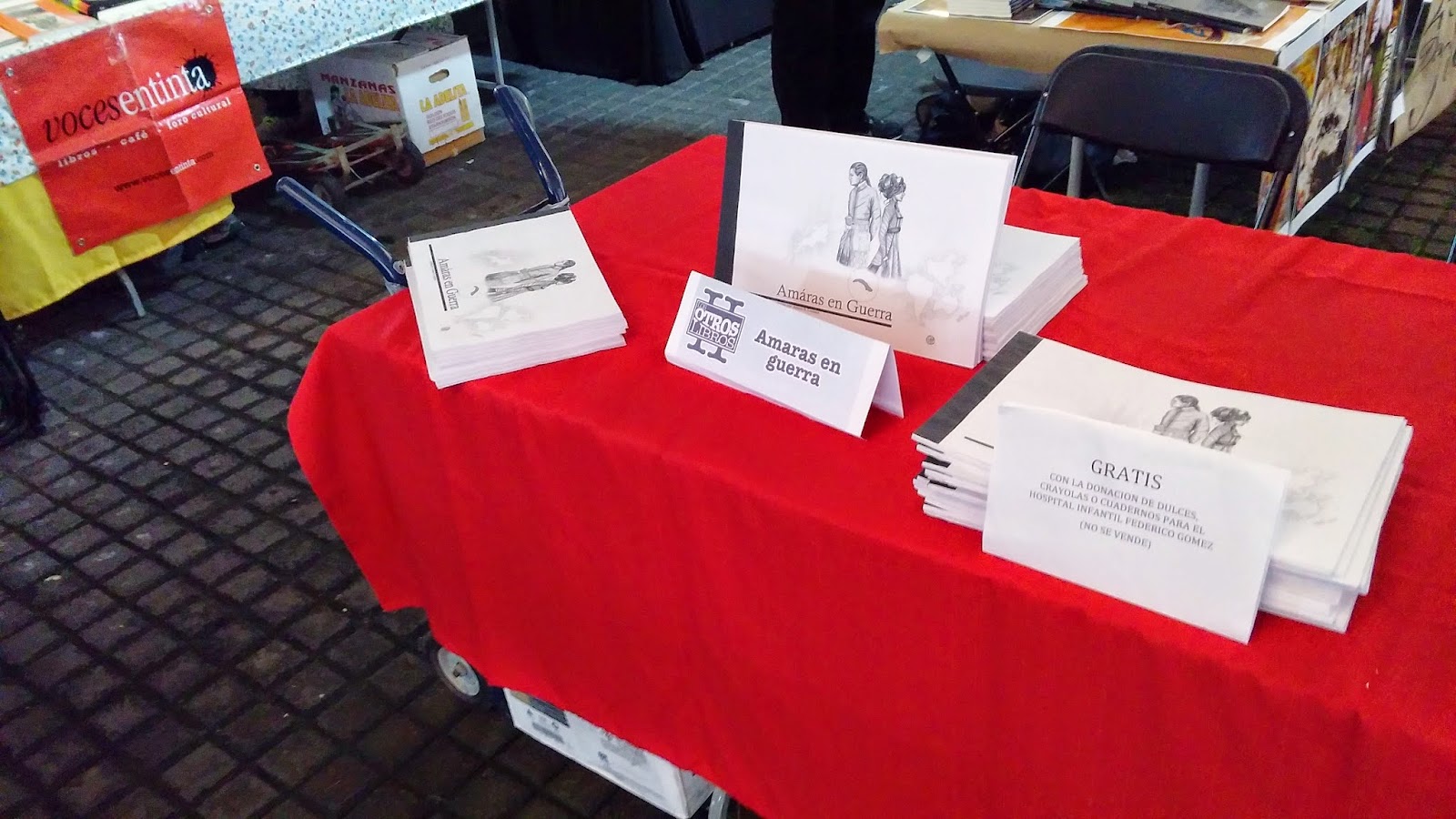
Como siempre, estuvimos regalando nuestra novela, pero también estuvimos solicitando crayolas, cuadernos y dulces para el hospital infantil Federico Gómez ubicado en Dr.Márquez No.162, Col. Doctores, Delegación Cuauhtémoc (México, D.F.). El hospital agradece estos insumos porque, según me cuentan en el  H. Cuerpo de Voluntarios (el link de la organización esta aquí: http://www.himfg.edu.mx/interior/voluntariashimfg.html), durante las consultas se le dan a los niños cuadernos para iluminar, hojas de papel y crayolas para que se entretengan mientras los atienden.

Agradecemos mucho a los que nos llevaron sus paquetes de crayolas y cuadernos y a los que nos los quedaron a deber, les recordamos que los voluntarios del hospital pueden recibir sus donativos (ya arriba tienen la página y la dirección del hospital).

El tianguis fue una experiencia muy interesante ya queque conocimos desde personas que están tratando de hacer un negocio con libros que son arte objeto (libros que están impresos en pequeñas cantidades y son específicamente para coleccionistas/fetichistas de los libros) hasta verdaderos luchadores sociales como Margarita Castillo, cuyo compromiso social y  enorme talento, la hacen una persona verdaderamente admirable (esperamos poder traducir alguno de tus trabajos a otro idioma para que se pueda distribuir en otros países Margarita).

Conocimos a los entusiastas editores  KGB con su antología "Penumbria"; a Cecilio Martínez Fernández con su excelente manual de redacción; a los señores de Editorial Disoluciones, quienes traen un proyecto muy lindo para lanzar nuevos escritores; a Editorial Paraíso Perdido (por quienes conocimos a la extraordinaria artista Diana Martin  y al escritor Rafael Villegas), a los creadores de "Cuentos del Batallón Perdido", a la gente de Moho, y Resistencia, entre muchas otras casas editoriales, cantidades bestiales de poesía, letras y locura.


Agradecemos infinitamente a Radio UNAM y a Andrea Castañeda que nos dieran la oportunidad de estar en este evento y esperamos que todas las personas que tuvimos el placer de conocer nos hagan llegar sus opiniones sobre Amarás en Guerra. 

lunes, 14 de abril de 2014

Nuestro proyecto editorial.

Nuestro proyecto nos ha llevado a encontrarnos con  una marginalización de la literatura no sólo por la gente que se rehúsa a leer, sino también porque desafortunadamente, la mayoría de los medios de producción literaria provocan que la gente se niegue a leer.

Si bien es cierto que existen países en los cuales el hábito de la lectura es casi tan común como el de comer tres veces al día y diariamente, lo cierto es que eso no ocurre en los países de latino América y ello no sólo obedece a una población inculta y de moral olvidada, sino a un anquilosamiento de los procesos de producción literaria.

Es innegable que el productor sólo puede importar las cosas del reino de la posibilidad utilizando lo que tiene a mano y así, realmente no hay forma de saber si Cervantes hubiera optado por escribir a su ingenioso hidalgo teniendo la posibilidad de mostrarlo con  una cámara de alta definición o si los cientos de metros cúbicos que ahora ocupan los enormes volúmenes de "El Señor de los Anillos" en las bibliotecas de todo el mundo no se verían libres si Tolkien hubiera sido ejecutivo o amigo de un ejecutivo de HBO (y para muestra está "Game of Thrones").

Contrario a lo que sucedía en otros tiempos, los contadores de historias de nuestro tiempo tienen más que un papel y una pluma a su alcance para llegar al público y ya no sólo hay bibliotecas en misteriosos monasterios o juglares y troupés para que el publico pueda conocerlas.

Muchas personas con una calidad intelectual más encumbrada de quien escribe en este blog, pueden pensar que lo anterior es una pena y que el ver cómo "el placer de la lectura" se va disminuyendo con los años es algo poco menor a una tragedia causada invariablemente por la televisión (so caja idiota) el cine y hasta el Internet.

Respetamos las opiniones de tan justas damas y virtuosos varones, pero no podemos compartirlas porque si bien es cierto que el leer puede ser un placer y una llama que enciende el motor del imaginario siempre superior a cualquier efecto especial o truco de ordenador, también es cierto que la lectura es un medio demasiado lento cuando se compara con la alternativa y no todos tendrán razón para soportar tal lentitud. 

Hay quienes disfrutarán de leer  ciento cuarenta y cinco páginas en las que se nos narra con doloroso detalle cada facción, idea, movimiento y hasta genealogía de un personaje que va de su dormitorio hasta la salida del pueblo (estimando un tiempo de lectura de un día), pero ello no implica que se pueda culpar a quien prefiere ver una versión del personaje abandonando el mentado pueblo en una pantalla usando sólo unos minutos.  Si, quizá la persona que vea la pantalla no estará encendiendo su motor imaginario para alcanzar la altura de justas y virtuosos, pero sin querer ofender a nadie, hay que reconocer que el tiempo libre lo es porque ni justos, ni virtuosos, ni templarios ni santas ni endiablados pueden dictar lo que se debe hacer con él.

¿Por qué una persona va a invertir todo su tiempo libre en las disertaciones que un autor lleva a cabo para explicar la forma en que un personaje sale de su pueblo?

¡Porque lo disfruta! Y ¡Albricias que así sea! Pero no todos tienen ese gusto y es que habiendo tantas cosas que hacer en días esplendorosos se podría antojar a desperdicio el abandonarse a los designios de alguien que escribe y si además resulta que termina por no ser de nuestro agrado... ¡Tortura pura!

Pensemos en una persona que se enfrenta a una marejada de libros. ¿Por qué habría de elegir alguno?
Quizá porque hay una recomendación, quizá porque una portada o un título le llamó la atención, quizá porque de leer una sinopsis o incluso algunos párrafos deduce que su contenido habría de gustarle.

El lector potencial decide pasar de la potencia al acto y elige el libro. Para poder darse a la lectura normalmente tendrá que asumir la responsabilidad que llevarlo a casa traerá consigo, a saber: o lo paga (si lo compra) o asume el compromiso de salvaguardarlo y devolverlo en buen estado (si lo toma de una biblioteca pública). El leer usualmente lleva un precio en sí mismo además de la necesidad implícita del tiempo que el lector dedicará a la lectura a menos que el material de lectura sea obsequiado... Y llega a su hueco favorito de lectura y pasan párrafos, pasan hojas, pasan capítulos y resulta que la recomendación mas bien terminó siendo discurso de borracho-marihuano, la portada no tenía nada que ver con el contenido, la sinopsis nunca explico que el autor sería demasiado vulgar o demasiado refinado o demasiado "demasiado" para hacer su oficio y/o; que los párrafos que se pudieron leer antes de la elección del libro eran los únicos que realmente iban a gusto del lector.

Si se pagó un precio por el volumen elegido, dinero tirado a la basura; si se tomó de una biblioteca, se emprenderá el camino de regreso a devolverlo cuidando siempre que no se dañe so-pena de tener que pagarlo y tirar el dinero a la basura.

Veamos el contraste con la televisión: el espectador prende la televisión (ya la tiene, no paga nada, ni adquiere una obligación alguna al encenderla), empieza a ver un programa y si no le gusta lo más que podrá haber invertido son... ¿Qué? ¿dos horas? Y eso en el caso de que el televidente no haya cambiado el canal al momento en que el programa dejo de gustarle y, sufriendo de una extraño caso de disciplina cuasi-castri-traumática, se fajó en su macho para verle el fin.  (¿Es viable decir que un libro nos disgusta en sólo dos horas cuando ya pagamos por él y quizá en las dos horas no hayamos llegado ni a la mitad?).

La inversión en tiempo y dinero que se requiere para disfrutar un programa de televisión es y siempre va a ser menor a la que se invierte en un libro y eso es algo que pocas personas toman en cuenta.  Los virtuosos y las justas podrán gritar, pero leer es una inversión de alto riesgo en la mayoría de los casos.

El lector normalmente no sabe si lo que va a leer le gustará (puede asumirlo, puede estar casi seguro, pero no lo sabe "con certeza") y en ese sentido es francamente desafortunado (por no decir "imbécil") el que se pretenda que haya lectores que además tengan que asumir un cargo (precio y/o obligación) sólo para averiguar si la obra que tienen en las manos les merece más tiempo.

Existen iniciativas como las ferias o "remates" de libros que se aprecian como una alternativa para que los lectores potenciales se acerquen a las obras literarias sin temor de hacer un gran desembolso monetario, sin embargo, aunque estas iniciativas son loables, consideramos que existen otras alternativas.


Puede parecer que los libros no tienen un alto costo, pero quien piensa eso sólo está tomando en estimación el costo monetario de un libro y no el tiempo que el lector va a invertir en averiguar si el libro que tiene en las manos merece ser leído de cubierta a cubierta o no... UN LIBRO ES ALGO MUY CARO PORQUE IMPLICA COMPROMETER EL TIEMPO DEL LECTOR, una obligación de pasar su tiempo en párrafos ajenos y que, a diferencia de los medios audiovisuales, difícilmente será menor a dos horas.

Nosotros consideramos que la producción editorial debe cambiar su enfoque y reconocer la valía del tiempo del lector sin perder su capacidad de auto-financiarse y es que, independientemente de consideraciones altruistas, la literatura es una empresa cultural que al ser parte de la cultura (por eso de llamarse "empresa cultural"), tiene un contenido económico que se ha de considerar para seguir existiendo.

La primera intención de nuestro proyecto es que el lector no invierta ni su tiempo ni su dinero en un producto que no es lo que pensaba, que le permita dejar de leer en el momento en que quiera si algo no le gustó sin tener que asumir pérdidas de carácter monetario o  disciplinas de milicia orate de esas que empujan "hasta la victoria, la muerte, o la última página".  Queremos que la gente eche un vistazo al universo que proponemos en "Amarás en Guerra"; que conozca a sus personajes, sus paisajes, sus honras, deshonras y cuitas para que decida si quiere o no hacerlo suyo antes de que pueda invertir un centavo o más de quince minutos; queremos que la audiencia sea más que un lector ocasional y esté en posibilidad de decidir si lo que le ofrecemos merece continuar con su participación viva o mejor quedarse en el baúl de buenas intenciones. 

Para lo anterior distribuimos (1000 ejemplares) de la novela en diversas ferias y eventos que nos lo permitieron.  Optamos por repartir ejemplares físicos y no electrónicos porque en primer lugar no queremos circunscribir la lectura únicamente al entorno digital y, en segundo lugar porque queremos darles a nuestros  lectores  algo que puedan tener entre sus manos para recodar nuestro proyecto; algo que nos permita vincularlos más con "Amarás en Guerra" y puedan, si así lo desean, guardar un "momento mori" de un sueño que en eso quedo o bien la rara y primera edición de una obra exitosa (todo depende de su aceptación finalmente).

Puede que muchos de los que lean la novela la encuentren aberrante, pero contamos con que habrá quien la considere merecedora de seguir existiendo  y quiera sumarse a nuestra iniciativa no sólo difundiéndola, sino teniendo plena disposición para ayudarnos a financiar una continuación si cree que el proyecto lo merece (la novela está "diseñada" para permitir al menos una continuación).

Así pues, les pedimos que revisen este blog y si les gusta nos ayuden a difundir el proyecto para que por juego estadístico podamos llegar al máximo número de personas posibles y, más aún, al máximo número de personas posibles que gusten de nuestro proyecto y no lo sepan todavía.

Actualmente estamos tratando de reunir fondos para una edición definitiva en la que incluiremos las sugerencias de nuestros lectores y tantos capítulos como sea necesario para aterrizar todas las cuestiones que pudieran haberse quedado en el tintero.  Lo anterior mediante la venta de una edición impresa y el acopio de donativos a cambio de diversas recompensas.

Esperamos lograr nuestro objetivo: establecer un proyecto literario que dependa única y exclusivamente de la aceptación de su público.

Agradeciendo su atención,

El equipo de "Amarás en Guerra".

domingo, 6 de abril de 2014

Nos pusimos Medievales

El día de ayer, 4 de Abril, tomamos el camión para "La Marqueza" (así decía el letrero del camión) y después de caminar algo así como 2 kilómetros cuesta arriba, llegamos al Valle de las Monjas, paraje boscoso que se había transformado en un campo de refugiados de la edad media y si no de la edad media, del reino de fantasía que cuando niños admitimos como terreno para nuestros más apreciados cuentos de hadas.

El III festival medieval de la Marquesa organizado por "Mundo Medieval" tuvo a bien recibirnos con los brazos abiertos y pudimos repartir entre sus asistentes ejemplares de nuestra novela mientras degustamos aguamiel de Hrotgar Artesanías (es verdaderamente bueno!!!) y cervezas de las casas Calavera (su Mexican Stout es Imponente) y Mytica (su gothra extra stout es demasiado buena!), de quienes realmente ya somos fanáticos.

¡En 30 minutos repartimos los 40 ejemplares que llevamos!

Esperamos que quienes nos hicieron favor de aceptarlos nos regalen sus opiniones y comentarios.
Y aunque lo decimos mucho, se vale volverlo a hacer:

¡GRACIAS!